Blaze Masters
Educational Forest Management Simulator developed in collaboration with Utah Department of Forestry, Fire, and State Lands
Contributions
-
Served as Scrum Master and utilized Trello to keep the 5 person team on pace
-
Led project pitch and One-Sheet design, coordinated with forest management agencies for consultation, led research for educational aspects of the game
-
Mediated an intense conflict within the team and persuaded all parties to commit to a unified team effort
-
Co-designed and iterated on Survey, Cut, Plant, and Extinguish mechanics
-
Pitched in with QA, Audio, and Writing efforts
-
Tools: Unity, Github, Trello
-
Platforms: PC, iOS
-
Team: 5 people
Cody Cottrell
Game Designer
Contributions
-
Represent Level Design department at all sprint, milestone, & retrospective meetings; assign tasks to junior LD in Coda
-
Identify pipeline inefficiencies & risks & offer solutions
-
Be a bridge between design, programming, & art teams; responsible for communicating Creative Director’s narrative vision within relevant contexts for cross-functional disciplines
-
Solely responsible for designing, developing, iterating, & documenting over 60% of playable areas within project scope
-
Design, script, & implement objectives, puzzles, & micro-stories
-
Apply stakeholder critiques & playtester feedback to relentlessly iterate engaging, atmospheric, readable blockouts
-
Mentor a junior level designer in tools, methods, & metrics
-
Navigate challenges of rapidly growing company, an engine change, & shifts in creative vision
Project: Playtime
Live-Service Asymmetric Multiplayer Horror inspired by titles like Dead by Daylight
-
Tools: Unreal Engine 4, Perforce, JIRA, Coda, Miro
-
Platform: PC
-
Part of team: 08/23 - 12/23
Level Walkthrough:
Misfit Pit
Level Goals
-
Create an engaging new map using 100% recycled assets.
-
Present a choice around every corner.
-
Foster "hold your breath" moments via risk/reward hiding spots.
-
Support chase gameplay via branching loops and plentiful sightlines.
-
Balance gameplay for all 3 monsters and their unique abilities.
Main Design Skills Used
-
Player choice payoffs
-
Chases should never peter out but rather end with the punctuation of a slam door, hold your breath moment, or kill.
-
-
Landmarks and districts
-
Teams need to always be able to identify where they are and a recognizable landmark that they're heading toward so they can quickly communicate via callouts and orient themselves in sync.
-
-
Informational sightlines, emotional sightlines, and functional sightlines
-
Pockets of sight from across the level give information about where the action is happening, the map's octagon structure creates "around the corner" sightings with enough distance for a chase to safely start (aka "oh crap" moments), and the micro pathing within branching loops forces split-second choices that make or break striking-distance attack lines.
-
Specific Example Breakdowns
1st Floor (0:00 - 1:13 in video)


-
Player choice payoffs
-
The slam door on this floor (southeast highlight) is positioned to effectively end chases by affording the Monster no good sightlines to where the Specialist is going after using the slam door and no good detours to quickly catch up.
-
Using this slam door pays off player choice by strongly "punctuating" chases that are very likely to be close based on a lack of distance-buying tools in the immediate area.
-
-
Landmarks and districts
-
The control room section of the map (southwest highlight) is an effective landmark for the following reasons:
-
Its elevated platform structure contained within the confines of the 1st floor space is unique in the map.
-
Its shape language is unique in the map.
-
Its floor material and props are both unique in the map.
-
It's intuitive what the space is and therefore easy for players to name and callout.
-
-
-
Emotional sightlines
-
The octagonal structure of the map makes for many "around the corner" emotional sightlines such as the generator cage section of the map (western highlight).
-
These sightlines evoke an emotional response because when the Specialist and Monster both round different corners and meet in the same straightaway at the same time, there's enough distance between them that a functional attack isn't yet possible but the sightline is so clear that a chase inevitably begins. Specialists know that they must either turn and run or expertly utilize the environmental tools in the area to evade the charging Monster.
-
The emotional response can be heightened in this area because the presence of a revival hatch and a power generator give Specialists two very specific gameplay reasons to travel to the area, thus heightening the stakes if a Monster appears and forces a detour of the Specialist's intentions.
-
2nd Floor (1:14 - 2:38 in video)


-
Player choice payoffs
-
The hiding nook right next to the hatch drop to the lower floor (eastern highlight) provides players with a high risk / high reward "hold your breath" moment that ends the chase one way or the other.
-
Using this obscured nook to hide from a pursuing Monster rather than simply dropping down the hatch into a new chase loop pays off player choice in extremes because there's no quick path back to the 2nd floor after dropping through the hatch: either the Monster drops through the hatch without checking the nook and the Specialist can breathe a sigh of relief, or the Monster does check the nook and the Specialist is cornered.
-
-
Landmarks and districts
-
The Toy Machine section of the map (northern highlight) is an effective landmark for the following reasons:
-
Its swing bridge / catwalk drop to the 1st floor is the most unique and engaging navigational node in the map.
-
Its lighting is visible from every floor of the map's central bridges and platforms.
-
It has a physical presence on all three floors and is therefore a relevant callout from anywhere.
-
The color-coded districting of the floors makes it easy to identify which level of the landmark you're at.
-
-
It's the only gameplay objective on the map that there's only one of and it plays a vital role in match progression.
-
-
-
Functional sightlines
-
The aforementioned swing bridge / catwalk drop serves as a functional sightline in a number of ways:
-
First and foremost, because the gap opens access to the Toy Machine from both the 1st and 2nd floors, it allows Specialists to functionally choose entirely different angles of Toy Machine engagement and escape routes.
-
Because of the three Monster types' different abilities, it functionally requires one of the Monsters (Huggy) to navigate the obstacle differently than the other two can.
-
The multi-floor nature of the gap allows players to functionally treat it as a swing bridge speed boost that continues the 2nd floor loop, a drop that transitions to the 1st floor loop, a double-back pivot point, and more.
-
The leadup to the gap from either side is obscured enough that if a Monster and Specialist arrive at opposite sides simultaneously, they're functionally a split-second outside of striking range.
-
-
3rd Floor (2:39 - 3:38 in video)


-
Player choice payoffs
-
The revival hatch within the central platform (central highlight) is highly exposed, but it's also frequently out of the way. The only time that it would be the closest 3rd floor hatch for a Monster to deposit an incapacitated Specialist in would be if the incapacitation takes place in the northern section or the central platform itself.
-
Using this revival hatch to deposit downed Specialists pays off the Monster player's choice by essentially allowing them to lay a trap for the other Specialists who expose themselves to try reviving their teammate.
-
-
Landmarks and districts
-
The melting pot section of the map (southern highlight) is an effective landmark for the following reasons:
-
It's defined by a hero prop that's more visually impressive than anything else in the map.
-
Its lighting and emissive materials are visible from every floor of the map's central bridges and platforms.
-
It has a physical presence on all three floors and is therefore a relevant callout from anywhere.
-
The color-coded districting of the floors makes it easy to identify which level of the landmark you're at.
-
-
It's intuitive what the space is and therefore easy for players to name and callout.
-
-
-
Informational sightlines
-
The pockets of windows--especially broken ones--around the map (northwest highlight) ensure that there are almost always clear informational sightlines from the central area to each floor's outer rim and vice versa.
-
The distance and navigational barriers between the windows and the central platforms prevent player sightings from escalating into chases, but the frequency of sightlines helps both the Monster and the Specialists to always be aware of where the action is happening so that they can flow toward it.
-
Informational sightlines like these windows are especially important in a game where one team is incentivized to avoid the other. If the Monster didn't have a steady stream of clues guiding them to targets, matches would suffer from long, boring, conflict-free stretches.
-
Main Lesson Learned
Competitive multiplayer design is all about setting the board for a series of split-second chess matches.
-
The moment where this really dawned on me was specifically while working on the placement of the yellow floor's slam door. Given slam doors' ability to directly throw a 3-second-long roadblock in the middle of a chase, their placement could mean the difference between a chase instantaneously going cold or growing into a pulse-pounding epic with a player mistake proving to be the line between life and death.
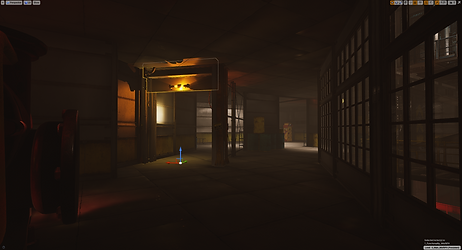

Initial Placement
Final Placement
VS
-
For simplicity's sake in this example, I'm just going to demonstrate the potential outcomes of a Specialist using the slam door in either scenario assuming that they are being DIRECTLY chased by the Monster the entire time. Of course that's often not the case as players adopt advanced feinting strategies, but the differences we'll see in the two door placements tend to be even more pronounced when the Monster is chasing from a parallel lane rather than direct.
-
I've provided slides demonstrating four possible vectors of approach that players can take to both slam door versions.
-
Red lines are just there to better visualize the walls that create the four vectors of approach.
-
Yellow lines represent the Specialist player's initial movement before using the slam door.
-
After using a slam door, the Specialist player almost always has different types of route options to take:
-
Orange lines are viable but non-ideal routes that are likely to lead to a very tight chase and quick death.
-
Green lines are optimally balanced routes that buy the Specialist enough time to gain some distance but not so much that the Monster is likely to lose track of them. These routes make for chases that grow from one interesting choice to another as players move between branching loops.
-
Blue lines effectively end chases by allowing Specialists to break line-of-sight for so long that the Monster can only guess where to pursue next. These routes have a purpose, as "punctuating" a chase can be rewarding for Specialists, but I wanted to reserve those routes for the slam doors on the upper and lower floors while making the middle floor's slam door a catalyst for expanding chases.
-
-

Western approach, chased through upper path

Western approach, chased through lower path

Eastern approach, chased through lower path
Western approach, chased through upper path
-
Initial Placement analysis:
-
0 optimally balanced routes.
-
Every approach features a chase-ending route so there's no reason to ever choose a different option.
-
In the western upper path approach, the non-ideal routes to the central bridge and upper floor are likely to be almost as bad as charging directly toward the Monster.
-

Western approach, chased through upper path

Western approach, chased through lower path

Eastern approach, chased through lower path
Western approach, chased through upper path
-
Final Placement analysis:
-
6 optimally balanced routes and every approach features at least 1.
-
No approach features a chase-ending route; paired with proximity to multiple floor transitions and the central bridge, that makes this slam door an excellent catalyst for unpredictable chases that grow through the entire map.
-
All of the non-ideal routes are equally viable.
-
Initial Placement
Final Placement
VS
-
What is it that leads to such a drastic difference in two door placements that are a mere 12M apart?
-
The length of the eastern dividing wall is 1/3rd that of the western dividing wall.
-
By moving the slam door closer to the eastern wall, it still buys the Specialist precious time but presents a significantly shorter detour for the Monster to get back on the same side of the barrier as the Specialist.
-
The Specialist can still briefly break line-of-sight as they branch off to a new loop, but the Monster doesn't fall so far behind that the player gets two loops ahead (aka, gone with the wind).
-
-
-
This one example demonstrates the level of analytical "if, then" thinking demanded by every single gameplay element and layout detail in a competitive multiplayer map. A high density of simple choice points is what makes for infinitely re-playable maps filled with emergent player stories! A one second difference in line-of-sight can drastically affect the exponential potential of those choices.