Blaze Masters
Educational Forest Management Simulator developed in collaboration with Utah Department of Forestry, Fire, and State Lands
Contributions
-
Served as Scrum Master and utilized Trello to keep the 5 person team on pace
-
Led project pitch and One-Sheet design, coordinated with forest management agencies for consultation, led research for educational aspects of the game
-
Mediated an intense conflict within the team and persuaded all parties to commit to a unified team effort
-
Co-designed and iterated on Survey, Cut, Plant, and Extinguish mechanics
-
Pitched in with QA, Audio, and Writing efforts
-
Tools: Unity, Github, Trello
-
Platforms: PC, iOS
-
Team: 5 people
Cody Cottrell
Game Designer
Contributions
-
Represent Level Design department at all sprint, milestone, & retrospective meetings; assign tasks to junior LD in Coda
-
Identify pipeline inefficiencies & risks & offer solutions
-
Be a bridge between design, programming, & art teams; responsible for communicating Creative Director’s narrative vision within relevant contexts for cross-functional disciplines
-
Solely responsible for designing, developing, iterating, & documenting over 60% of playable areas within project scope
-
Design, script, & implement objectives, puzzles, & micro-stories
-
Apply stakeholder critiques & playtester feedback to relentlessly iterate engaging, atmospheric, readable blockouts
-
Mentor a junior level designer in tools, methods, & metrics
-
Navigate challenges of rapidly growing company, an engine change, & shifts in creative vision
Poppy Playtime:
Chapter 3
Puzzle-based Survival-Horror inspired by titles like Portal and Five Nights at Freddy's
-
Tools: Unreal Engine 5, Perforce, JIRA, Confluence, Miro, DungeonDraft
-
Platforms: PC, PlayStation, Xbox, Switch
-
Dev Time: 11/22 - 01/24
Level Walkthrough:
Home Sweet Home
Level Goals
-
Establish critical narrative threads and reinforce worldbuilding through environmental storytelling.
-
Showcase a new type of environment for the series via exploration-based puzzling.
-
Introduce and tutorialize the gas mask mechanic.
Main Design Skills Used
-
Atmospheric foreshadowing
-
Lighting cues
-
Districting
Level Flow Breakdown
Section 1 - Introductory Area (0:00 - 1:57 in video)
Preview the main objective location, tutorialize the gas mask and wind-up car mechanics

1st floor flow

Basement floor flow

Basement floor zoom in
1st floor flow
-
Atmospheric foreshadowing
-
The locked central door with the sun decal on it (2A), paired with the locked doors to the left and right and their respective half-sun decals foreshadows the main objective and sub-objective progression.
-
The blocked door in the basement section provides a small glimpse of where players will complete the level's ultimate objective of re-routing the generator power (the window on the door should be bigger though).
-
Players a presented with a new mechanic--the wind-up car (3A)--and see that it can destroy crates to open pathways, which they'll need to do again later.
-
-
Lighting cues
-
The power room (14) is the most well-lit area in the section, reinforcing its over-arching importance.
-
-
Districting
-
The central hub room is defined by its wide open space, verticality, and wood textures, all in stark contrast to the claustrophobic brick tunnels of the basement that players drop into (2B).
-
Section 2 - Obstacle 1 Area (1:58 - 5:24 in video)
Build atmosphere through exploration, environmental storytelling, and item retrieval

1st floor flow

2nd floor flow

2nd floor zoom in
1st floor flow
-
Atmospheric foreshadowing
-
The secret observation room that players enter (4) directly foreshadows the one they'll find a required pickup in later on (13C).
-
The battery in the back slot of the collapsed observational bear statue (6C) directly foreshadows the one they'll need to obtain from the functioning observational bear statue later on (10B).
-
-
Lighting cues
-
The flickering light that can be seen through a ceiling hole (6B) draws attention to hanging cables and guides players to look up to see the Climb Handle they can use to progress to the upper floor.
-
-
Districting
-
The lower girls' wing is defined by individual bedrooms, twin beds, and claustrophobic spaces, in contrast to the communal bunk and crib rooms of the upper girls' wing.
-
Section 3 - Transition Area (5:25 - 6:34 in video)
Reward player progress with a fun and destructive moment, reinforce the main objective


-
Atmospheric foreshadowing
-
The 2nd wind-up car (7B) reinforces that the cars can break down progress gates and foreshadows where they'll find the final battery pickup later on in the expansive Section 6.
-
The well-lit power room from the 1st floor is visible as players pass over the central hub's 2nd floor balcony, reminding players of the objective they're working toward.
-
If players look into the windows of the upper boys' wing as they pass through the central hub, the observational bear statue puzzle and its battery (10A) are foreshadowed.
-
-
Lighting cues
-
The power cable that players activated on the 1st floor is also visible from the 2nd and feeds into the power room.
-
-
Districting
-
The central hub room's wise open negative space contrasts with the cluttered bunk room of the upper girls' wing.
-
Players can get a better view of both the girls' and boys' wings through the numerous windows on the second floor and clearly take note of the pink and blue color coded wallpaper.
-
Section 4 - Obstacle 2 Area (6:35 - 7:59 in video)
Challenge players with a familiar puzzle mechanic


-
Atmospheric foreshadowing
-
Players can get another glimpse of the observational bear statue puzzle by looking through a barricaded doorway.
-
-
Lighting cues
-
The flickering green light of the hanging power source (9A) stands out against the darkness in a room where players are intentionally meant to feel trapped, guiding them toward the puzzle solution.
-
-
Districting
-
To call out an area with room for improvement, the boys and girls' wings don't feel distinct enough beyond the color-coded wallpaper. Early blockouts featured themed beds that differentiated the boys' and girls' bunkrooms but they were out of art scope. The Creative Director wanted architectural symmetry, so distinguishing the rooms architecturally was out too. In retrospect, I think that unique mural decals may have been a potentially helpful tool.
-
Section 5 - Obstacle 3 Area (8:00 - 9:00 in video)
Challenge players to retrieve an item via a unique environmental puzzle that aids worldbuilding


-
Lighting cues
-
The green light of the power source in the spiral stairway (11C) previews an aspect of a puzzle on the 1st floor.
-
-
Districting
-
The observational bear statue (10A) is functional, in contrast to the collapsed one in the girls' wing. In general, the boys' wing features much less damage than the girls', though the difference isn't as stark as it should be to properly distinguish the districts.
-
Section 6 - Obstacle 4 Area (9:01 - 12:10 in video)
Escalate the challenge by combining all previously encountered mechanics in service of an extended environmental story
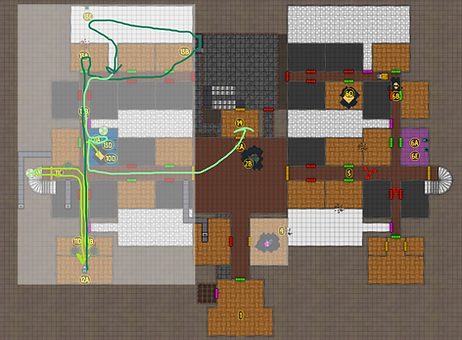

-
Atmospheric foreshadowing
-
When players see the 3rd wind-up car (12A), the earlier progression of cars reinforces exactly what they need to do in order to progress in the most open and expansive section of the level.
-
Players get a good glimpse of level's main objective in the generator room when passing through a vent (13B).
-
-
Lighting cues
-
The green light of the power source in the spiral stairway (11C) highlights the final element players need to complete the puzzle to access the wind-up car in the contraband room.
-
Upon loading both battery pickups and initiating the daytime power cycle (13D), the power cables activate and visually guide players back to the central hub and the now unlocked power room.
-
Section 7 - Narrative Advancement Area (12:11 - 14:51 in video)
Reinforce the game's high-level objectives with a "generator puzzle" that rewards the player with narrative progress once they return to the game's central hub

1st floor flow

Basement floor flow

Basement floor zoom in
1st floor flow
-
Districting
-
The power room and generator room are defined by their brick textures, in stark contrast to the wood and wallpaper of the rest of the level.
-
Main Lesson Learned
-
Level Design and Environment Art must work as a team!
-
While I do think that the overall level flow in this complex Resident Evil mansion style layout is successful, I think that the product as a whole fails to achieve all of my design goals, largely due to lack of cohesive teamwork.
-
So much of my vision didn't come through because I failed to proactively seek buy-in from the art team, so once I transferred to another project after our Alpha milestone, there was no one to fight for the integrity of the blockout whenever changes were proposed. Changes were frequently made without design or narrative considerations in mind. A few of the more detrimental changes are listed below:
-
The secret observation rooms attached to the bedrooms on the 1st floor (seen in Sections 2 and 6) aren't characterized by the clinical look and feel from the blockout, leading to a lack of clarity over what they are and their narrative importance.
-
A large crack in the observation window to the bedroom that the third wind-up car crashes into (Section 6, 13A)--which served the purpose of reminding players of the observation rooms and hinting at the location of the final battery pickup (13C) in the blockout--did not make it into the final version, leading to a lack of player guidance in the level's most expansive section.
-
The locked room in the central hub which leads to Section 7 was changed from a Head Master office--which featured elements that tied the day / night (sun / moon) rationed power system and together--to a utility room preceding a larger utility room, leading to a lack of narrative cohesion in the level objectives.
-
Lastly, while this is less of an issue regarding collaboration between Level Design and Art, it's worth noting that the puzzle that I'd designed and prototyped for the generator room in Section 7 (15) heavily utilized the presence of the "red smoke" gas which the gas mask mechanic was specifically designed for, but when the puzzle was swapped out for another designer's without looping me in, that element was lost, undermining both the narrative and the utility of the gas mask mechanic. Had I made efforts to more collaboratively build the vision for the room with Environment Art, somebody on their team may have spoken up in my absence once I was on another project.
-
-